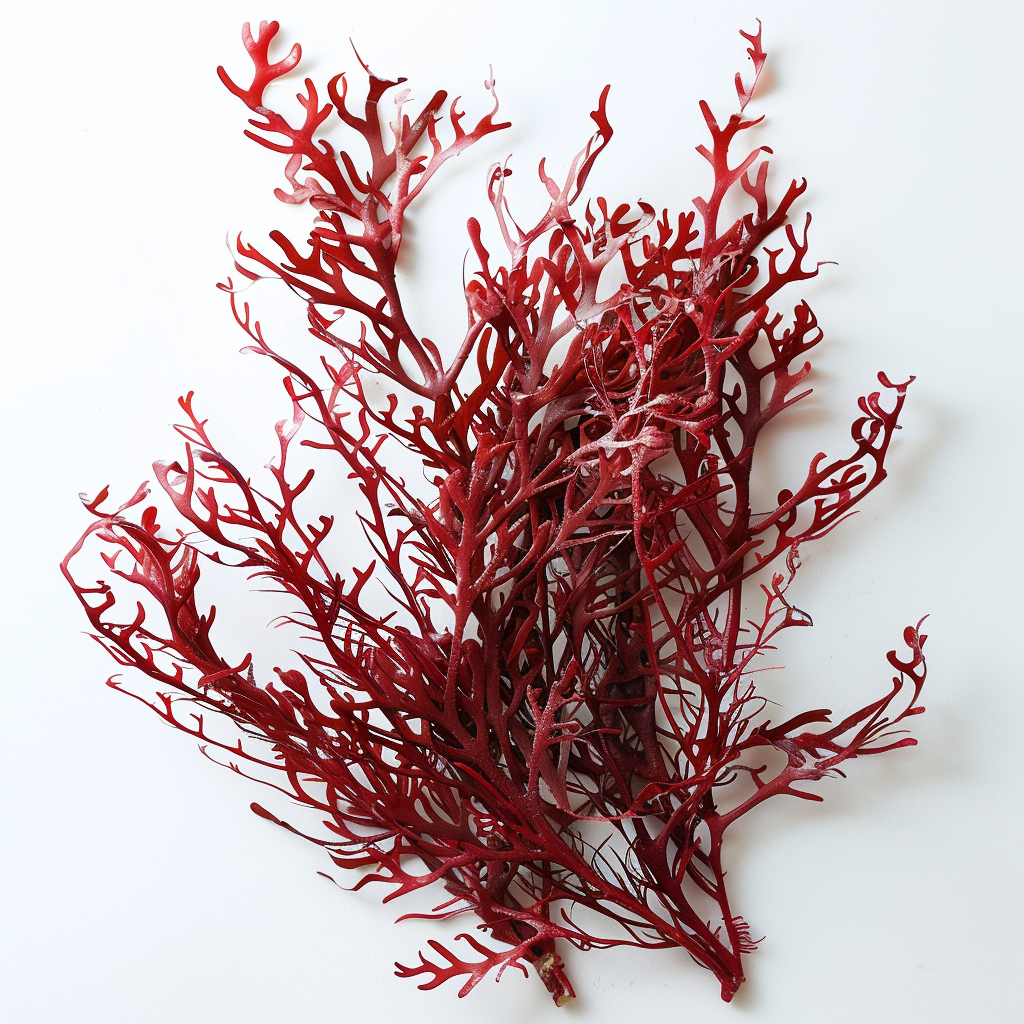
When most people think of seaweed, they picture kelp forests, sushi wrappers, or maybe the crispy seaweed snacks found in grocery stores. But seaweed is not one single ingredient. It is an entire world of edible ocean plants — and some of the most protein-rich types are not green or brown, but red seaweed!!
What makes red seaweeds especially interesting is their natural protein content. Reviews of red macroalgae have found that some red seaweeds can reach protein concentrations up to about 47% of dry weight, making them some of the highest-protein macroalgae studied so far.
Why Are Some Red Seaweeds So High in Protein?
Red seaweeds grow in coastal waters where they absorb dissolved nutrients directly from the ocean. Unlike land crops, they do not need soil, irrigation, or synthetic fertilizer to build biomass. Their protein levels vary by species, season, water nutrients, growing conditions, and how they are processed, but several edible red seaweeds are naturally rich in amino acids.
This does not mean every red seaweed is automatically a “protein food.” Some red seaweeds are more famous for their gelling carbohydrates, like agar or carrageenan, while others — especially nori and dulse — are better known as edible, nutrient-dense sea vegetables.
1. Nori / Laver / Gim
Species: Pyropia yezoensis, Pyropia haitanensis, Pyropia seriata, Pyropia dentata
Where it grows: Japan, Korea, China, and other temperate coastal regions
Farmed or wild? Heavily farmed
Taste: Savory, roasted, umami, slightly briny
Nori is probably the most familiar red seaweed in the world. It is the thin dark sheet wrapped around sushi rolls, folded around rice balls, or toasted into snack sheets. Although it looks almost black or green after drying and roasting, nori comes from red seaweed species in the Pyropia and Porphyra group.
Nori is also one of the clearest examples of red seaweed as a high-protein food. Research on Pyropia notes that it is rich in protein, amino acids, vitamins, carbohydrates, and minerals, and that it is among the highest-value seaweeds cultivated at large scale.
Commercial farming of Pyropia/Porphyra has a long history in East Asia. Seaweed Insights notes that nori farming dates back to at least the 1600s, with industrial cultivation expanding after artificial seed production and synthetic nets were developed in the mid-20th century. Today, nori is very much a farmed seaweed, especially in China, Japan, and Korea.
2. Dulse
Species: Palmaria palmata and related Palmaria species
Where it grows: North Atlantic and North Pacific coasts, including Ireland, Iceland, Atlantic Canada, Maine, and parts of northern Europe
Farmed or wild? Mostly wild-harvested historically, with growing cultivation research and some tank-based production
Taste: Savory, smoky, earthy, umami; sometimes compared to bacon when cooked
Dulse is one of the most beloved edible red seaweeds in the North Atlantic. It has been eaten for centuries in places like Ireland, Iceland, Atlantic Canada, and coastal New England. Britannica describes dulse as an edible red alga found along rocky northern Atlantic and Pacific coasts that can be eaten fresh or dried.
From a food perspective, dulse is exciting because it has a rich savory flavor and a relatively high protein range. A review of Palmaria palmata describes it as a commercially important red macroalga distributed along North Atlantic shores, historically used as food for centuries and currently hand-harvested in Western Europe, Canada, and Maine. The same review notes that because demand is increasing, future growth cannot rely only on wild harvest, and cultivation work is underway.
The National Seaweed Hub describes dulse as deep rose to reddish-purple, with an earthy dried flavor and “rich umami smokiness” when cooked. It also notes that in the United States, dulse is grown in land-based tanks, while open-ocean farming methods are still being developed.
3. Ogo / Limu Manauea
Species: Gracilaria spp., including Gracilaria parvispora
Where it grows: Hawai‘i, California, Florida, Connecticut, tropical and temperate coasts worldwide
Farmed or wild? Both; farmed in tanks, fish ponds, and aquaculture systems
Taste: Clean, floral, lightly umami, crunchy, refreshing
Ogo is a beautiful branching red seaweed widely used in Hawaiian food, especially poke. It is crunchy, fresh, and more “vegetable-like” than many dried seaweeds. The National Seaweed Hub describes ogo as a bushy red seaweed found in almost all the world’s oceans, with forms ranging from deep purple and string-like to light orange, thick, and crunchy. It also notes that long ogo, Gracilaria parvispora, is cultivated in Hawai‘i in floating baskets on fish ponds, while other Gracilaria species are farmed on the U.S. West and East Coasts.
Globally, Gracilaria is one of the most important farmed red seaweeds. Seaweed Insights describes Gracilaria and Gracilariopsis as red seaweeds grown primarily for agar extraction or abalone feed, and notes that Gracilaria is the third-largest farmed seaweed group by production volume globally.
In other words, ogo is not just a wild coastal delicacy. It is also becoming part of modern aquaculture, including land-based and integrated farming systems.
4. Irish Moss / Carrageen
Species: Chondrus crispus
Where it grows: North Atlantic rocky coasts, especially Ireland, Atlantic Canada, New England, and northern Europe
Farmed or wild? Mostly wild-harvested, with some cultivation and selected commercial production
Taste: Mild, oceanic, often used for texture more than flavor
Irish moss, or carrageen, is another classic red seaweed from the North Atlantic. It is less famous as a protein ingredient and more famous for its natural gelling power. Historically, it has been used to make puddings, soups, jellies, and traditional drinks.
Seaweed.ie describes Chondrus crispus as a source of carrageenan and notes its use in soups, jellies, and Irish traditional remedies. It also notes that small amounts are still collected in Ireland for cooking and health drinks, while some cultivated color and morphological variants are sold dried as novelty salad products.
Irish moss is a good reminder that red seaweeds are diverse. Some are used as everyday vegetables, some as seasonings, and some as natural texture-building ingredients.
5. Kappaphycus and Eucheuma
Species: Kappaphycus alvarezii, Kappaphycus striatus, Eucheuma denticulatum
Where it grows: Tropical waters, especially Indonesia, the Philippines, Tanzania, and other warm coastal regions
Farmed or wild? Heavily farmed
Taste: Usually mild; more often processed for carrageenan than eaten as a whole vegetable
Kappaphycus and Eucheuma are tropical red seaweeds that have become major global aquaculture crops. They are not usually the red seaweeds people think of when they picture protein-rich sea vegetables, because their main commercial use is carrageenan extraction.
Seaweed Insights describes eucheumatoids as tropical red seaweeds commercially farmed since the 1970s in Southeast Asia, especially for carrageenan. Common cultivated types include cottonii, Kappaphycus alvarezii, spinosum, Eucheuma denticulatum, and Kappaphycus striatus.
These species matter because they show how red seaweed farming already exists at major scale. Even when they are not marketed as “protein foods,” they are part of the global red seaweed economy.
So, Are Red Seaweeds the Future of Ocean Protein?
Potentially — but with nuance.
Red seaweeds are genuinely exciting as protein sources. Some, like nori and dulse, are naturally high in protein and already have strong culinary identities. Others, like Gracilaria, are promising because they can be farmed in tanks, ponds, or integrated aquaculture systems. Reviews of red seaweed proteins emphasize their potential for food and nutraceutical applications, while also noting that extraction, digestibility, bioavailability, safety, and scaling still need more work.
The current state is mixed:
| Red seaweed | Protein potential | Farming status | Main use today |
|---|---|---|---|
| Nori / Pyropia | Very high | Heavily farmed | Sushi sheets, snacks, seasonings |
| Dulse / Palmaria | High | Mostly wild + emerging cultivation | Snacks, flakes, seasoning, specialty foods |
| Ogo / Gracilaria | Moderate to high | Farmed and wild | Fresh sea vegetable, agar, aquaculture |
| Irish moss / Chondrus | Moderate | Mostly wild + some cultivation | Gels, drinks, carrageenan |
| Kappaphycus / Eucheuma | Variable | Heavily farmed | Carrageenan |
Where Seaghetti Fits In
Seaghetti (my first seaweed brand!) is made from nutrient-rich brown and green kelp, designed to bring the ocean’s nutrition into a familiar pasta format. Red seaweeds are part of the same bigger story: seaweed is not just a garnish or a sushi wrapper. It is an entire category of ocean-grown food with texture, flavor, minerals, fiber, and in some species, naturally impressive protein.
That is what makes seaweed so exciting. Brown kelps, green seaweeds, and red seaweeds each bring something different to the table. Some are best for noodles, some for snacks, some for umami seasonings, and some for future protein ingredients. Together, they point toward a more diverse, ocean-powered food system.
Final Thoughts
Red seaweed is one of the most overlooked protein stories in food. Nori has already become mainstream through sushi and snacks. Dulse is gaining attention for its smoky, savory flavor. Ogo brings crunch and freshness to Hawaiian cooking. Gracilaria, Kappaphycus, and Eucheuma show that red seaweed aquaculture can scale far beyond wild harvest.
The red seaweeds of the world are flavorful, nutrient-dense, and in many cases surprisingly protein-rich — and they may become an important part of how we think about sustainable food from the ocean.